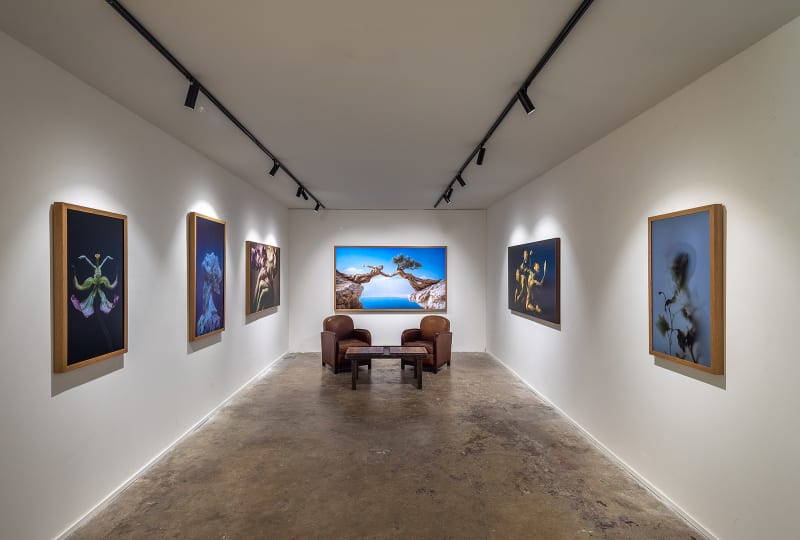
Windows of Hope is Roy Adin’s first solo exhibition in Israel – an artist working at the intersection of art, nature, and artificial intelligence.
Curated by Ariel Rom Cohen
Windows of Hope is Roy Adin’s first solo exhibition in Israel – an artist working at the intersection of art, nature, and artificial intelligence.
Since the dawn of art history, painting has been defined as a “window onto reality”: a frame through which the viewer contemplates the world. In an age where reality itself is mediated through screens, Adin reintroduces this concept into the center of his artistic inquiry, yet subtly undermines it from within. Instead of painting on canvas, he creates through artificial intelligence. Instead of a physical window, he presents screens of various sizes, and alongside a gaze directed outward at the world, he invites one inward – into the human consciousness itself.
The gallery space in this exhibition fills with a constellation of screens that echo the architecture of windows, from each a different reality unfolds, yet all share a similar gaze: quiet, contemplative, imbued with longing. The works, composed of multiple layers of generative imagery, function as “living organisms”. They breathe, move, and loop endlessly, much like nature, from which they draw inspiration. Their slow, meditative motion stands in contrast to the accelerated digital realm and invites the viewer to pause and look more closely.
Born in Jerusalem in 2001, Adin began his artistic path in animation, creating short films that reached millions of viewers worldwide. In his current practice, he employs AI tools not as a substitute for human creativity but as a raw material for shaping images that search for meaning and emotion. Human and natural imagery merge into intimate scenes that sustain an ongoing dialogue between the organic and the technological.
There is something ironic, almost paradoxical, in Adin’s deep engagement with the natural world through the most artificial of mediums. In a time when many perceive technology and nature as opposing forces, Adin seeks to reconcile them. For him, both stand as fundamental pillars of human existence: one rooted in life’s essence, the other in consciousness and evolution. His works thus propose a form of reconciliation between these two poles; an invitation to view artificial intelligence not as a threat to the human, but as a natural continuation of our curiosity, creativity, and imagination.
Whether depicting landscapes, bodies, or motion, Adin’s works inhabit the threshold between illusion and reality, between machine and man. They embody a subtle paradox: employing the most advanced technology to express our most primal human needs: for breath, connection, and hope.
The title Windows of Hope arises from the idea of the window as a space of transition: between interior and exterior, between the self and the world, between what is known and what has yet to be seen. In an era where our lives unfold across endless “open windows” on our screens, Adin offers a different kind of window, one that allows not only a view outward, but also a reflection inward. In times when hope can feel like a scarce resource, these works invite us to look beyond mere longing, reminding us that it is still possible to see, to imagine, to breathe, and to believe.
