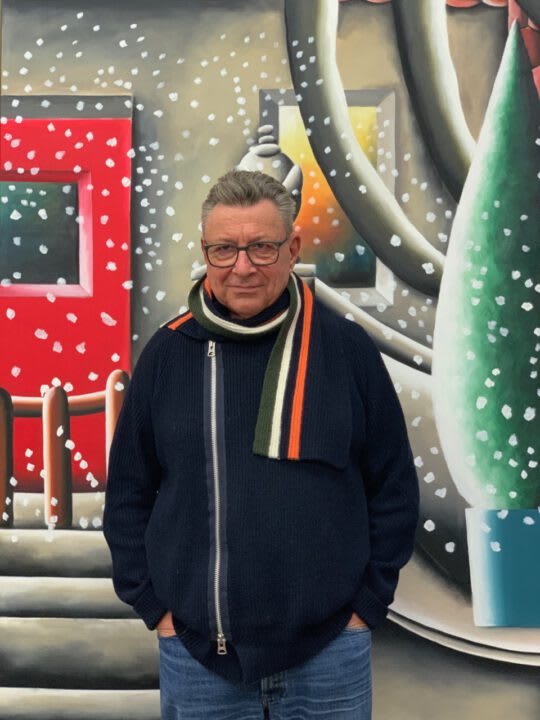
He is one of the great individualists of German painting. Based in Cologne, he has been associated with the gallery since 1983. Since the early 1980s, Schulze has deliberately positioned his work outside prevailing painterly trends, developing a distinctive visual language that combines representation with the absurd.
His paintings defamiliarize basic design, architectural, and everyday forms, oscillating between gentle irony and quiet menace, comfort and unease. Drawing from a repertoire of middle-class emblems—peas, geraniums, sofas, cars, porcelain dishes, windows, or prefabricated houses—Schulze arranges commonplace objects into humorous yet unsettling tableaux. Interiors and landscapes merge, geometric and biomorphic forms collide, and familiar motifs reappear in recurring series of spheres, windows, and cars that resemble playful assemblages.
While his work engages with art historical references ranging from Oskar Schlemmer’s Triadic Ballet to Pop Art, Surrealism, and naïve painting, Schulze resists avant-garde grandiosity. Balancing abstraction and figuration, his images remain recognizable yet destabilized, often appearing inflated, soft, or strangely surreal.
Through radical simplification and painterly humor, Schulze exposes the blind spots of bourgeois life—mocking its fetishes while simultaneously acknowledging the comfort and reassurance they provide.