
One of the defining figures of Israeli conceptual art, Pinchas Cohen Gan has spent more than five decades exploring a question that is both deeply personal and universal: where does a human being belong?
Born in Meknes, Morocco, in 1942, Pinchas Cohen Gan immigrated to Israel with his family in 1949. He grew up in Kiryat Bialik, largely surrounded by European Jewish immigrants, and later described the profound sense of cultural distance he experienced as a North African Jewish child in the young State of Israel.
That feeling of existing between places, identities and cultures would become fundamental to his art.
Throughout his career, Cohen Gan has moved between painting, drawing, printmaking, installation, performance, philosophy and writing. Yet beneath these different forms lies a remarkably consistent investigation of the individual: the human being attempting to find a place within geography, history, society and systems of knowledge.
The Landscape as an Experiment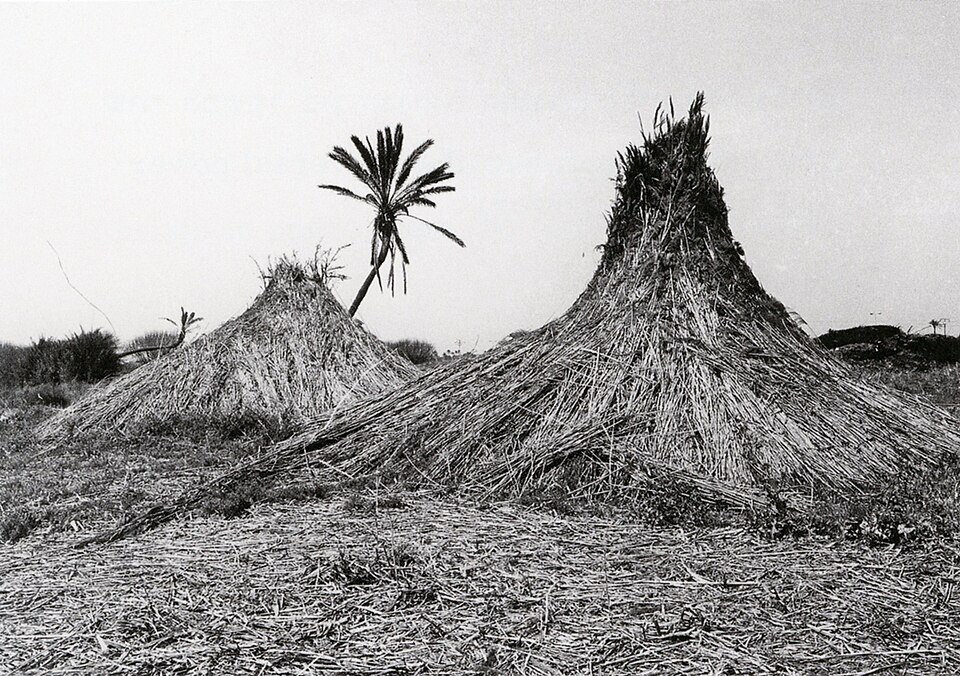
Cohen Gan emerged as an important voice in Israeli art during the early 1970s, when a generation of artists was beginning to challenge the traditional boundaries of painting and sculpture.
His earliest significant works were not necessarily objects at all. They were actions.
In The Dead Sea Project (1972–73), Cohen Gan created plastic structures through which fresh water was introduced into the environment of the Dead Sea, attempting to sustain fish within a landscape naturally incapable of supporting them.
The experiment was physical, but its implications extended far beyond ecology.
The fish became a powerful metaphor for displacement: a living organism placed within an environment to which it does not belong, forced to survive through an artificial system.
The idea echoed questions that Cohen Gan had experienced personally as an immigrant.
What does it mean to exist somewhere while simultaneously feeling foreign to it?
Touching the Border
Borders became another central element of Cohen Gan’s early practice.
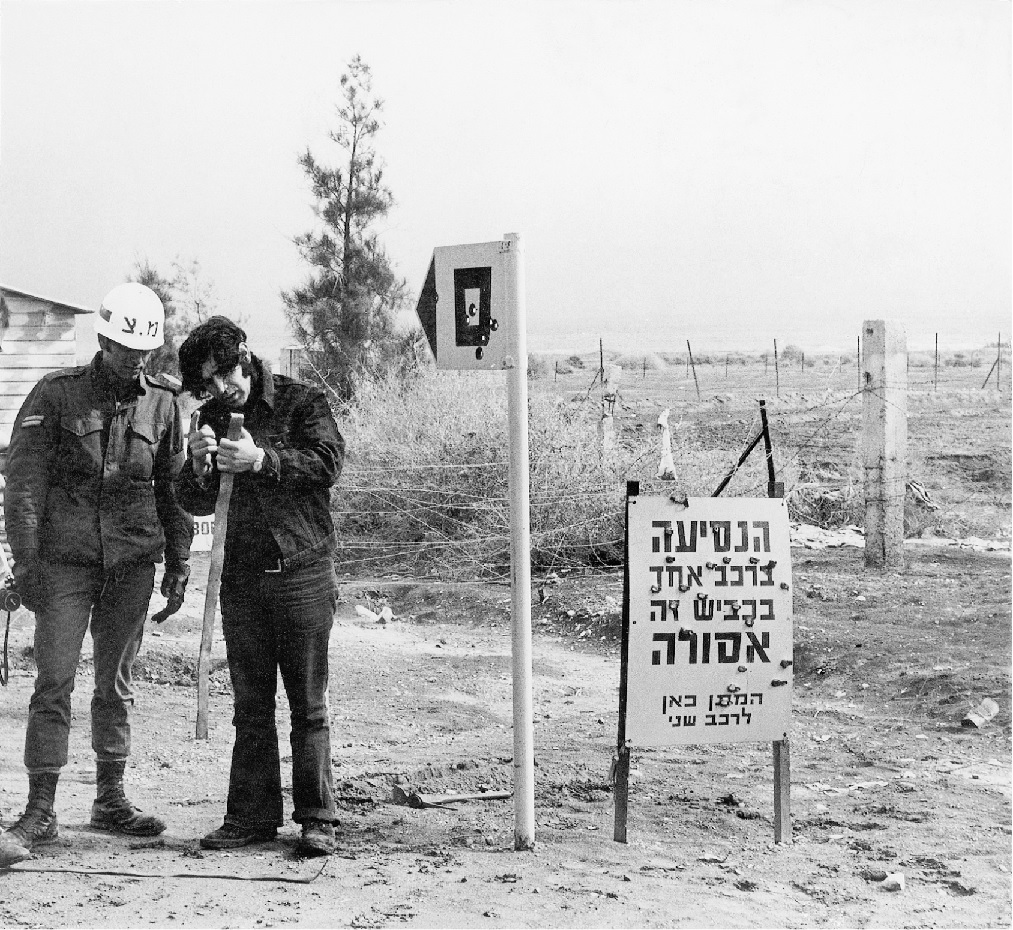
In Touching the Border (1974), he attempted to reach different borders of Israel carrying steel elements containing demographic information. Where security forces prevented him from continuing, the objects were placed.
The work transformed the geographical border into something conceptual.
A border was no longer simply a line on a map. It became a point at which movement stops, identity is defined and belonging is questioned.
Other actions from the period similarly addressed migration, refugees, territory and cultural isolation.
These works placed Cohen Gan among the artists expanding the possibilities of conceptual art in Israel. But unlike conceptualism concerned primarily with the definition of art itself, Cohen Gan’s experiments repeatedly returned to the human condition.
From Concept to Canvas
By the late 1970s, Cohen Gan began returning increasingly to painting.
But he did not leave conceptual art behind.
He brought it with him.
His canvases became spaces where apparently incompatible languages could coexist: expressive painting alongside mathematical equations, diagrams, geometric structures and fragments of text.
Cohen Gan became fascinated by the tension between art and science.
Could emotion be calculated?
Could beauty be expressed through a formula?
Could the complexity of human existence ever be contained within a rational system?
He developed what he called a theory of “relative art,” approaching artistic creation as a network of relationships between culture, nature, knowledge and perception.
The paintings sometimes appear almost like attempts to solve an equation.
But there is always something that refuses to be solved.
The human being.
The Figure
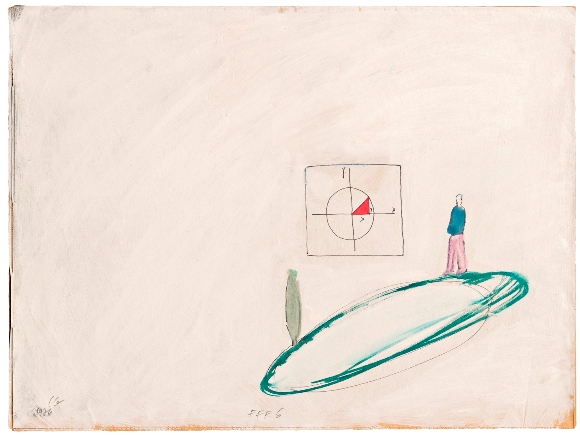
Figure, Form, Formula, 1976, ink, pencil and acrylic on paper, collection of Tel Aviv Museum of Art
Perhaps the most recognizable element of Cohen Gan’s visual language is the human figure.
His figures are deliberately anonymous.
Bodies are simplified into outlines. Faces lose their individual characteristics. At times the figure approaches the appearance of a diagram or mathematical symbol.
During the 1980s, Cohen Gan increasingly separated the head from the body. Floating heads appeared within fields of color, surrounded by geometric structures, numbers and formulas.
The human form became both universal and profoundly isolated.
It could represent anyone.
And therefore, perhaps, everyone.
Across Cohen Gan’s work, this anonymous figure exists between opposing forces: East and West, body and intellect, individual and society, emotion and rationality, belonging and alienation.
The surrounding world may be carefully measured and categorized, yet the human figure never fits perfectly within it.
Personal History Becomes Collective Memory
As Cohen Gan’s work developed during the 1980s and 1990s, his exploration of personal identity increasingly intersected with collective history.
Jewish memory and the Holocaust became important subjects within his practice.
In And These Are the Names, presented in Istanbul in 1992, Cohen Gan created works dedicated to Jewish communities from Europe and the Middle East that had been destroyed during the Holocaust.
Here again, history was approached through systems of names, classifications and memory.
But behind those systems were individual human lives.
This tension—between the abstraction of history and the experience of the individual—is central to understanding Cohen Gan.
The Artist as Thinker
Cohen Gan has never separated making art from thinking about art.
Alongside his visual practice, he has written extensively about aesthetics, philosophy and the structures through which art is understood.
His writings attempt to create systems for describing artistic creation, sometimes borrowing the language of mathematics, linguistics and science.
This intellectual dimension distinguishes his practice.
For Cohen Gan, painting is not simply an image.
It is a proposition.
A question.
Sometimes even an argument.
An Icon of Israeli Art
Pinchas Cohen Gan occupies a distinctive position in the history of Israeli art.
His biography as a Moroccan-born immigrant, his involvement in the emergence of Israeli conceptual art, his return to painting and his sustained investigation of identity allowed him to develop a language that was both intensely personal and intellectually rigorous.
Over the course of his career, he has received some of Israel’s most significant artistic honors, including the Sandberg Prize for Israeli Art in 1979, the Dizengoff Prize in 1995, the Ministry of Culture and Sport’s Lifetime Achievement Award in 2005, and the Israel Prize in Painting in 2008.
Yet perhaps his greatest contribution lies in the question running through more than five decades of work.
From fish attempting to survive in the Dead Sea to anonymous figures surrounded by equations, Cohen Gan continually returns to the same fundamental tension:
How does a human being find their place within a world determined by borders, histories, identities and systems?
His work never gives us a definitive answer.
Instead, it makes the question visible.
